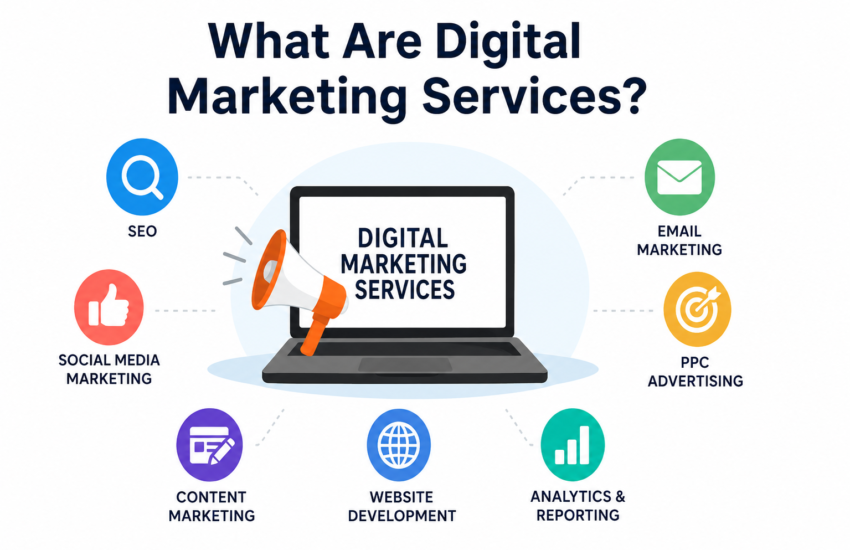
Digital marketing has become an essential part of how businesses attract customers, build brand visibility, generate leads, and increase sales. But with so many channels available. including SEO, social media, paid advertising, content marketing, and website development. it can be difficult to understand which services a business actually needs.
Digital marketing services are professional strategies and activities designed to help businesses reach their target audience through digital channels. Depending on the business model and goals, these services can include search engine optimization (SEO), social media marketing, performance marketing, content marketing, website development, local SEO, and conversion optimization.
The goal is not simply to generate more website traffic. A successful digital marketing strategy connects the right channels with the right audience and turns online visibility into meaningful business results.
Why Are Digital Marketing Services Important for Businesses?
Customers increasingly research businesses online before making a decision. They may search on Google, compare websites, check social media profiles, read reviews, or interact with online advertisements before contacting a company.
A well-planned digital marketing strategy helps businesses build visibility across these different stages of the customer journey. It can support goals such as:
- Increasing qualified website traffic
- Generating leads and enquiries
- Building brand awareness
- Reaching specific customer segments
- Increasing online sales
- Improving website conversions
- Measuring marketing performance
- Strengthening customer relationships
Another important advantage is measurability. Businesses can use performance data to understand which channels are attracting visitors, generating enquiries, or contributing to sales. This makes it easier to identify what is working and where the marketing strategy needs improvement.
What Are the Different Types of Digital Marketing Services?
Digital marketing includes several specialized services. While some businesses may focus heavily on one channel, others combine multiple services to create a complete marketing strategy.
Search Engine Optimization (SEO)
Search engine optimization helps businesses improve their visibility in organic search results. When potential customers search for products, services, or information related to a business, a strong SEO strategy can help the relevant pages appear more prominently.
Professional SEO services can include:
- Keyword research
- Technical SEO
- On-page SEO
- Content optimization
- Local SEO
- Ecommerce SEO
- Internal linking
- Off-page SEO
- Link building
- SEO performance reporting
SEO is generally a long-term strategy. Instead of paying for every website visit, businesses work to build sustainable organic visibility by improving their website, content, technical performance, and relevance to search queries.
For businesses targeting competitive markets, SEO can become an important source of qualified website traffic and leads.
Social Media Marketing and Management
Social media marketing helps businesses connect with their target audience through platforms such as Instagram, Facebook, LinkedIn, and other relevant networks.
Social media management services may include:
- Social media strategy
- Content planning
- Post creation
- Community management
- Audience engagement
- Social media advertising
- Performance monitoring
- Content scheduling
Social media is particularly useful for businesses that need to build brand awareness, communicate with customers, showcase products or services, and maintain an active online presence.
However, social media success should not be measured only by follower growth. Engagement, website visits, leads, enquiries, and conversions can provide a clearer picture of whether social media activity is contributing to business objectives.
Performance Marketing and PPC
Performance marketing focuses on measurable actions such as clicks, leads, conversions, and sales. Paid advertising platforms allow businesses to reach specific audiences based on factors such as search intent, demographics, interests, location, and online behavior.
Common performance marketing activities include:
- Google Ads
- Meta Ads
- Remarketing
- Conversion tracking
- Landing page optimization
- Audience targeting
- Campaign testing
- Performance reporting
Paid advertising can provide faster visibility than many organic strategies, but results depend on factors such as targeting, ad quality, offer, landing page experience, competition, and budget.
For this reason, running advertisements is only one part of performance marketing. Tracking what happens after a user clicks the advertisement is equally important.
Content Marketing
Content marketing focuses on creating useful and relevant content that attracts, educates, and supports potential customers throughout their buying journey.
Examples of content marketing include:
- Blog articles
- Industry guides
- Website content
- Educational resources
- Case studies
- Service-related content
- SEO content
A strong content strategy can support several digital marketing goals at the same time. Informational content can attract people who are researching a problem, while service-focused content can help users who are closer to making a purchasing decision.
Content marketing also works closely with SEO. Well-structured content can target relevant search queries while providing useful information to readers.
Website Development and Optimization
A website is often the central destination for digital marketing traffic. SEO, social media, paid advertising, and content marketing can bring visitors to a website, but the website needs to provide a clear and useful experience.
A business website should ideally be:
- Mobile-friendly
- Fast-loading
- Easy to navigate
- Search-engine friendly
- Secure
- Accessible
- Conversion-focused
Website development services can include business websites, ecommerce websites, custom development, design improvements, and conversion-focused optimization.
A technically sound and user-friendly website can help businesses make better use of traffic generated through other marketing channels.
How Do Digital Marketing Services Work Together?
One of the biggest mistakes businesses make is treating each marketing channel as a completely separate activity.
In reality, different digital marketing services can support one another.
For example:
SEO can attract people searching for relevant information.
↓
Content marketing can answer their questions and establish expertise.
↓
Social media can distribute useful content and maintain audience engagement.
↓
Paid advertising can reach targeted users and support campaigns that need faster visibility.
↓
Website development and optimization can provide the experience that turns visitors into enquiries or customers.
↓
Analytics and reporting can show which activities are contributing to business goals.
This connected approach can make a digital marketing strategy more efficient because each channel has a defined role instead of operating independently.
How to Choose the Right Digital Marketing Services for Your Business
There is no universal digital marketing package that works for every company. A local service business, ecommerce store, B2B company, and real estate business may require very different strategies.
Before choosing digital marketing services, consider the following factors.
Define Your Business Goals
Start by identifying what you want to achieve.
Are you trying to:
- Increase website traffic?
- Generate leads?
- Increase online sales?
- Build brand awareness?
- Improve local visibility?
- Retain existing customers?
Your goals should determine which digital channels receive the most attention.
Understand Your Target Audience
Knowing your audience is essential.
Consider where potential customers search for information, which platforms they use, what questions they ask, and what factors influence their purchasing decisions.
A B2B company may benefit from search visibility, industry content, and LinkedIn, while an ecommerce brand may require a combination of SEO, social media, paid advertising, and conversion optimization.
Evaluate Your Competition
Competitor research can reveal which channels are already producing visibility in your industry.
Look at:
- Search rankings
- Content quality
- Social media activity
- Paid advertising
- Website experience
- Offers and calls to action
The objective is not to copy competitors but to identify opportunities to create a stronger and more useful experience.
Consider Your Budget
Digital marketing should be realistic for the business’s resources.
Instead of spreading a limited budget across every channel, businesses can prioritize the services most closely connected to their goals and gradually expand as performance data becomes available.
Understand the Customer Journey
Customers rarely make every purchasing decision after their first interaction with a brand.
They may first discover a company through Google, read a blog article, visit a service page, see a social media post, compare alternatives, and eventually submit an enquiry.
Your digital marketing strategy should support these different stages.
Digital Marketing Services by Business Goal
Different business objectives may require different combinations of services.
| Business Goal | Useful Digital Marketing Services |
| Increase organic traffic | SEO + Content Marketing |
| Generate qualified leads | SEO + PPC + Landing Page Optimization |
| Increase online sales | Ecommerce SEO + PPC + Conversion Optimization |
| Build brand awareness | Social Media + Content Marketing |
| Improve website conversions | Website Development + Conversion Optimization |
| Reach local customers | Local SEO + Location-Based Marketing |
| Grow B2B leads | SEO + LinkedIn + Content Marketing |
The table is a starting point rather than a fixed formula. A business should evaluate its audience, competition, resources, and existing performance before selecting a final channel mix.
What Does a Digital Marketing Strategy Include?
A digital marketing strategy provides a structured plan for using online channels to achieve specific business objectives.
A typical strategy may include:
1. Business and Competitor Research
Understand the business model, market, competitors, existing visibility, and opportunities.
2. Target Audience Research
Identify the audience’s needs, questions, behavior, and purchasing journey.
3. Keyword Research
Find relevant search queries and organize them according to search intent and business value.
4. Channel Selection
Choose the channels that make sense for the target audience and business goals.
5. Content Planning
Create a content calendar covering informational, commercial, and supporting topics.
6. Campaign Development
Build SEO campaigns, social media campaigns, paid advertising campaigns, or other marketing activities.
7. Conversion Tracking
Track meaningful actions such as form submissions, calls, purchases, registrations, or enquiries.
8. Performance Monitoring
Review traffic, rankings, engagement, leads, conversions, advertising costs, and other relevant metrics.
9. Optimization
Use performance data to improve campaigns, content, landing pages, targeting, and budgets.
10. Reporting
Regular reporting helps businesses understand what has been completed, what is performing well, and what should be improved next.
How Much Do Digital Marketing Services Cost?
The cost of digital marketing services varies from one business to another. There is no single price that applies to every company.
Pricing can depend on:
- Number of services required
- Business size
- Industry competition
- Target market
- Target location
- Website condition
- Content requirements
- SEO difficulty
- Advertising budget
- Campaign complexity
For example, a small local business focusing on local SEO may have very different requirements from an ecommerce company targeting multiple countries.
Businesses should therefore compare the scope of work, strategy, reporting, expertise, deliverables, and expected business objectives rather than choosing an agency based only on the lowest price.
Digital Marketing Services vs. Doing Marketing In-House
Businesses can manage marketing internally, work with an agency, or use a combination of both approaches.
| Factor | Digital Marketing Agency | In-House Team |
| Expertise | Access to multiple specialists | Depends on internal team |
| Tools | Agency may already use specialist tools | Business provides tools |
| Scalability | Can often scale services as needed | May require additional hiring |
| Strategy | External perspective | Strong internal business knowledge |
| Cost structure | Service-based | Salaries, tools and training |
The right choice depends on the company’s size, resources, marketing requirements, and internal expertise.
Some businesses may also combine internal knowledge with external specialists. For example, an internal team can manage brand communication while an agency handles SEO, paid advertising, technical optimization, or content strategy.
Common Digital Marketing Mistakes Businesses Should Avoid
Even businesses investing in digital marketing can struggle when their strategy lacks direction.
Here are some common mistakes to avoid:
Trying Every Marketing Channel at Once
Using every platform does not automatically produce better results. Focus on channels that match your audience and objectives.
Focusing Only on Traffic
Traffic is useful, but business growth usually depends on meaningful actions such as leads, enquiries, purchases, or registrations.
Keyword Stuffing
Repeating keywords excessively can make content difficult to read and does not create a better experience for users.
Publishing Content Without Search Intent
A blog should answer a real question or solve a real problem rather than exist only to target keywords.
Ignoring Technical SEO
Slow pages, broken links, poor mobile usability, indexing issues, and other technical problems can affect how effectively search engines discover and understand a website.
Running Ads Without Conversion Tracking
Without proper tracking, businesses may know how many clicks they received but not whether those clicks generated meaningful results.
Having a Poor Website Experience
A website that is confusing, slow, difficult to navigate, or not mobile-friendly can waste traffic generated through other marketing channels.
Not Measuring Performance
Without regular measurement, it becomes difficult to identify which strategies deserve more investment.
Expecting Immediate SEO Results
SEO often requires consistent optimization, quality content, technical improvements, and time. Businesses should evaluate progress using appropriate milestones rather than expecting instant rankings.
How to Measure Digital Marketing Performance
The right metrics depend on the marketing channel and business objective.
SEO Metrics
Important SEO metrics can include:
- Organic clicks
- Search impressions
- Search rankings
- Organic traffic
- Organic conversions
- Indexed pages
Paid Advertising Metrics
For paid campaigns, businesses may monitor:
- Click-through rate
- Cost per click
- Cost per lead
- Conversion rate
- Return on ad spend
- Conversion value
Social Media Metrics
Useful social media metrics can include:
- Reach
- Engagement
- Audience growth
- Website traffic
- Leads
- Conversions
Website Metrics
Website performance can be evaluated through:
- Conversion rate
- Landing page performance
- Form submissions
- Engagement
- Sales
- Enquiry volume
The most important point is to connect these metrics to actual business objectives. A large amount of traffic is not necessarily valuable if visitors do not match the target audience or take meaningful actions.
How Long Does Digital Marketing Take to Show Results?
Digital marketing does not produce identical results across every channel.
SEO and content marketing generally require consistent work before significant organic growth develops. Technical improvements, content quality, competition, website authority, and search intent can all influence the timeline.
Paid advertising can generate visibility and traffic more quickly, but campaign performance depends on factors such as targeting, creative quality, offer, landing page experience, competition, and budget.
Social media growth can also vary depending on content quality, audience, consistency, platform, and engagement.
Instead of expecting every channel to deliver results at the same speed, businesses should establish realistic KPIs and evaluate progress based on the role each channel plays in the overall strategy.
Final Thoughts
Digital marketing services give businesses a structured way to attract, engage, and convert customers through online channels. However, successful digital marketing is not about using every available platform or publishing content simply for the sake of being active.
The better approach is to understand your business objectives and customer journey, then combine the services that support those goals.
SEO can build long-term organic visibility, content marketing can educate potential customers, social media can strengthen engagement, performance marketing can support targeted acquisition, and website development can help turn visitors into leads or customers.
When these activities work together as part of a clear digital marketing strategy, businesses can make better use of their online presence and measure progress using meaningful business outcomes.
If you are looking for professional support across SEO, social media, performance marketing, content marketing, and website development, explore NR Digital Agency‘s digital marketing services to understand how these services can be aligned with your business goals.
Frequently Asked Questions
What are digital marketing services?
Digital marketing services are professional online marketing activities that help businesses improve visibility, reach relevant audiences, generate leads, and increase sales through channels such as SEO, social media, content marketing, paid advertising, and websites.
What services are included in digital marketing?
Common digital marketing services include SEO, content marketing, social media marketing, performance marketing, PPC advertising, website development, local SEO, ecommerce marketing, and conversion optimization.
Which digital marketing service is best for a business?
There is no single service that is best for every business. The right combination depends on the business’s goals, target audience, industry, competition, location, website, and budget.
Is SEO part of digital marketing?
Yes. SEO is an important part of digital marketing. It focuses on improving a website’s visibility in organic search results and attracting relevant users through search engines.
What is the difference between SEO and paid advertising?
SEO focuses on improving organic search visibility, while paid advertising allows businesses to pay for targeted placements on advertising platforms. Many businesses use both approaches as part of a broader digital marketing strategy.
How do I choose a digital marketing agency?
Look at the agency’s relevant experience, services, strategy, communication process, reporting, case studies, and understanding of your business objectives. The cheapest option is not necessarily the most suitable option.
Can small businesses benefit from digital marketing services?
Yes. Small businesses can use digital marketing to improve local visibility, reach specific audiences, generate enquiries, build brand awareness, and compete for relevant online searches. The strategy should be scaled according to the business’s resources and objectives.
How do I know which digital marketing services my business needs?
Start with your business goals, target audience, existing online performance, competition, and customer journey. An audit can then help identify which channels are most likely to support those goals.
